
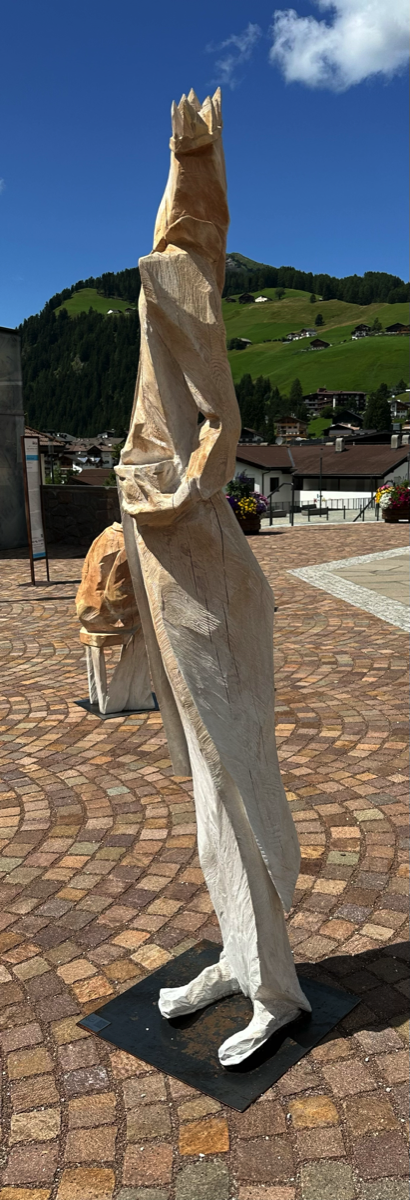
Barb felt as withered as this figure by an Ortisei artist looked after a few days of travel.
JULY 2025
Underway
On July 1, we were shouting from the roof tops the news that everyone had longed to hear: “We are doing well!” Together, we had died a thousand deaths while traveling to Europe in the face of unimagined frustration, anger, and disbelief. I had pressed on through endless hours of stroke-related dizziness, weakness, confusion, and general physical and psychic distress. Bill was only 2 months into the official 3-month recovery from his second ablation, which would in reality require a 4th month. We’d just now transitioned from barely surviving to beginning to thrive at the end of our first 3 weeks in Europe.
During the first few days on European soil in early June, we repeatedly exclaimed with tremendous relief and a tinge of disbelief: “We made it!” That was all that mattered in the moment: we had both overcome huge personal challenges in getting ourselves to Europe.
When in the hospital in early September and hearing my dreadful longterm prognosis from a neurologist, I literally didn’t expect to be alive in June. In April and May when we struggled with the “go-no go” decision to travel to Italy for the summer, I was overwhelmed because that decision went beyond my stroke-revised life expectancy and my mental calendar was blank. When we ran through the “What if’s” of possibilities if we traveled overseas and it didn’t go well, I included the scenario of me returning in a body bag at one end of the spectrum to which I quipped: “That should be a relatively easy outcome because the systems are all in place for managing the issue.”
So far, the absolute hardest part of the summer was as hard as expected: the several days of international travel by planes, trains, and ground transportation. Even with Bill shlepping the luggage, every footstep was a challenge for me from my most prominent stroke dysfunction: “gaze instability.” My gaze instability is non-stop when my eyes are open. I’m told I have the reaction time of a 20-year-old but after my eyes land on a target object, they constantly jitter sideways, which exhausts my brain and my brain fogs because of the incessantly changing, meaningless, input.
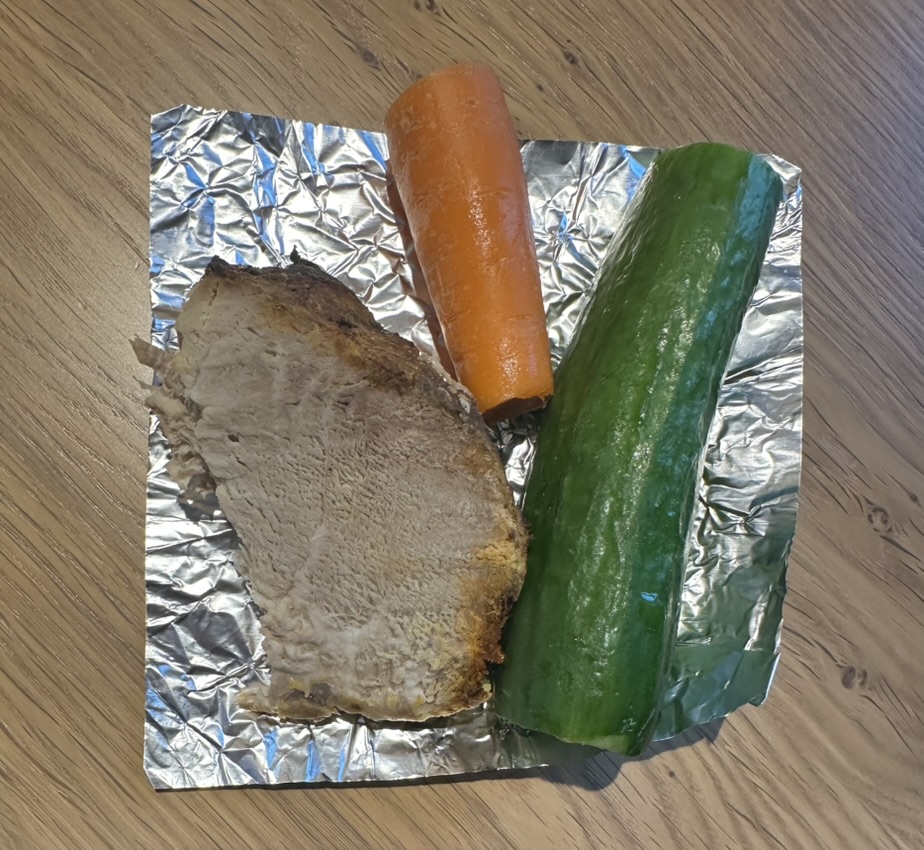
One of 2 precious bits of heavy aluminum foil from our transatlantic flight breakfast later served as plates for our “self-catered” meals while awaiting our luggage delivery.
Munich Debacle
The dark cloud that had been hanging over us for a year and had been increasingly oppressive, followed us to Europe in early June. We had hoped to ditch it on the trans-Atlantic flight but alas, it showed up in the rainstorm at Amsterdam where our flight to Munich was inexplicably cancelled. Our carrier quickly rebooked us on a competitor’s flight but unbeknownst to us, our 4 pieces of checked luggage were not included in the hand-off.
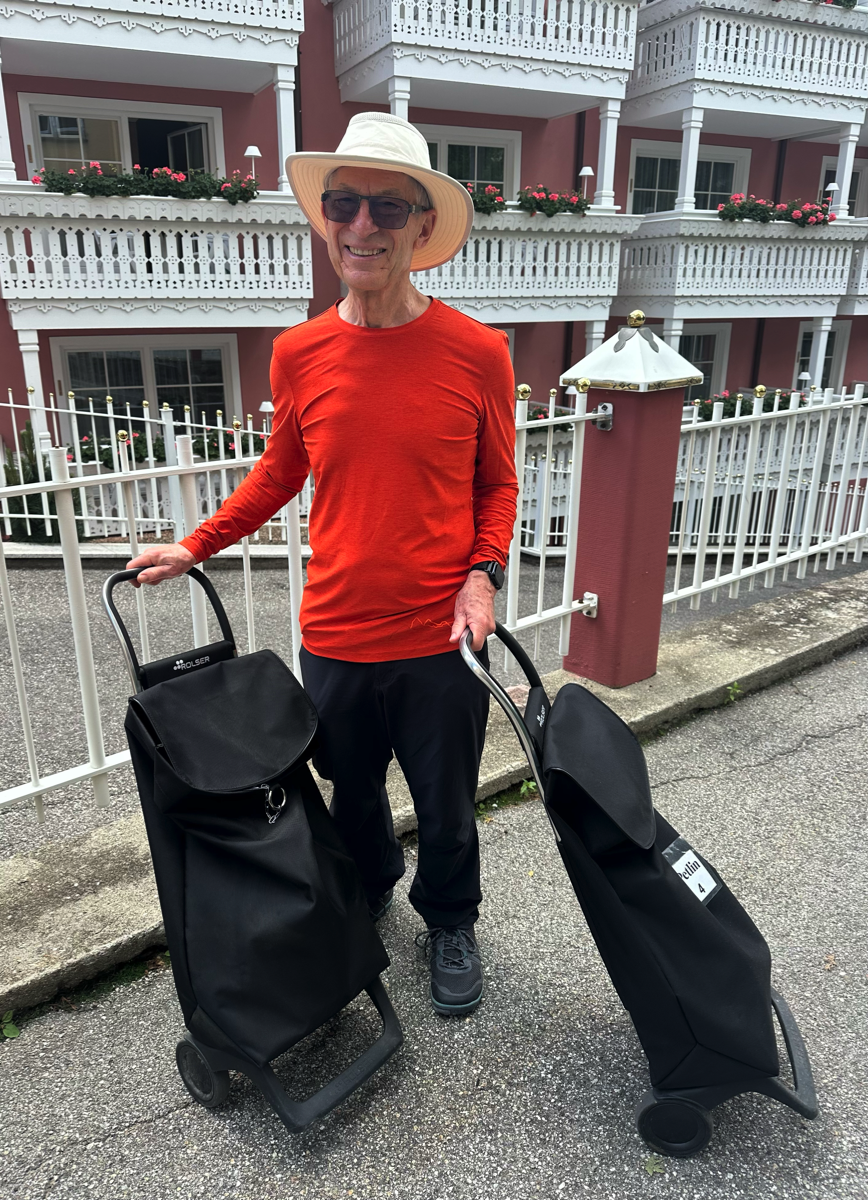
Our apartment complex’s free-to-borrow shopping carts eased our almost daily shopping.
Our 2nd choice of spending 3 nights in Bolzano before heading to the mountains made it easier to eventually receive our bags but it meant extra days spent in the unusual 100° heat where the air was heavily laden with Canadian wildfire smoke. I spent 1 full day confined to our studio apartment with effective AC and filters to spare my sensitive lungs from exposure to 6 times the recommended amount of highly toxic PM2.5s because my HEPA filter mask was in my luggage in Amsterdam. On Saturday when we rode the 25 miles into the mountains from Bolzano to Ortisei, the yellow haze from the smoke didn’t diminish as we went higher. We steeled ourselves to the threat of that pallor hanging over us for the entire summer. There would be no AC in the mountains providing relief from the heat or smoke that had already been lingering for a week because of the early heat wave.
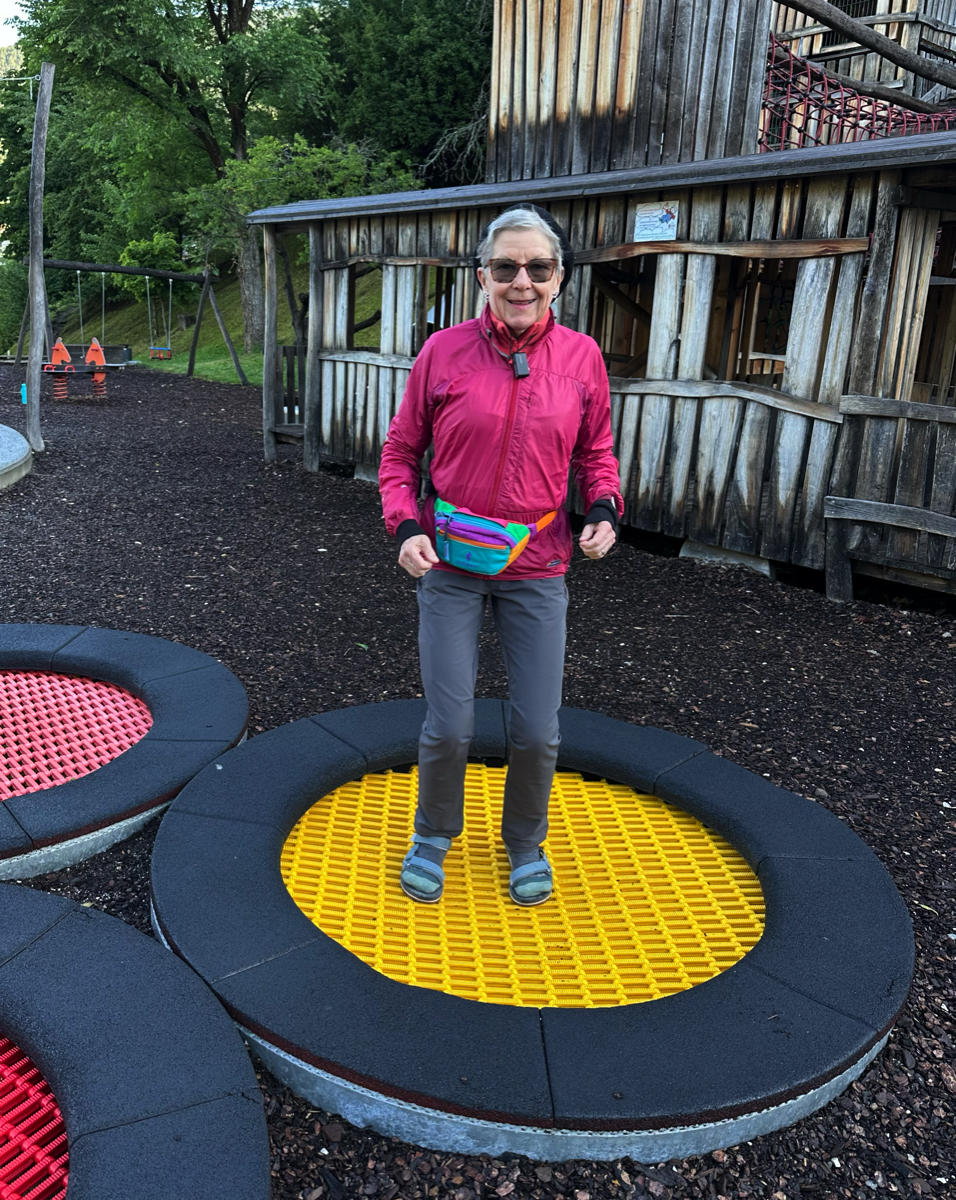
A new rehab exercise for Barb: mini trampolines.
We had been reunited with our luggage in smokin’ hot Bolzano the night before we traveled to our first mountain venue, Ortisei. There we were delighted to finally have a budget-friendly, tranquil, tourist apartment for 2 weeks in the village we’d stayed so many times. I had spotted the centrally located, unusually quiet complex a year before during my hunt specifically for something more to our liking.
We’d seen a small unit at that time but in the early winter, we’d been too late to reserve it and had to settle for a more expensive, 2-story apartment, which we immediately fell in love with when we stepped through the doorway. We were delighted to have the extra space, a more pleasing layout, and an overall brighter ambience even though our loft bedroom overheated each day. We knew then that it would be hard to leave for our usual apartment in Selva which was darker and had fewer surfaces on which to place things. The only thing lacking in Ortisei was a microwave, meaning we spent more time each day cooking, reheating food, and scrubbing pans. But at this gem, we had a clothes washing machine to ourselves instead of sharing one with a dozen other families like we would do in Selva and over the winter, they had added 2-wheeled shopping carts that were available to borrow.
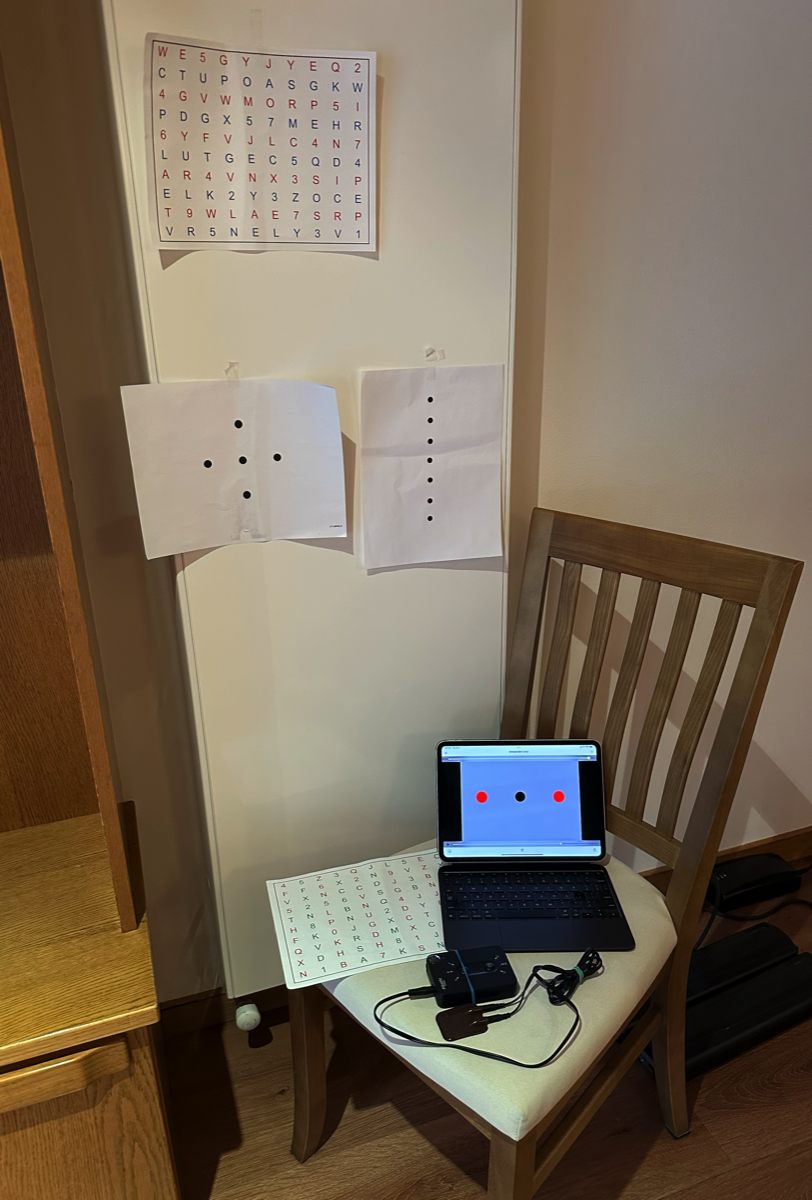
Barb’s eye exercise corner, including a TENS unit with tongue probe to stimulate her damaged brain stem.
After I somewhat recovered from the travel trauma, I resumed doing my 3-times-a-day eye exercises aimed at improving my gaze instability. Like they often do, initially the exercises were a set back and increased my level of daily distress but ultimately were a benefit.
With mixed emotions, we left Ortisei after 2 weeks and moved higher up the mountain to Selva for 2 months where our relatively new e-bikes and panniers with seasonal gear were stored each winter.
Even after a week in Selva, I could barely reach into my panniers to fetch stored belongings because of my profound sadness from encountering our via ferrata climbing gear, a sport my stroke had rendered impossible for me to ever do again.
My last big hikes “on the wire” had been in 2019. Covid had wiped out our annual trips to Italy in 2020 and 2021 and truncated our stay in ’22 to 1 month. At that time, we feared we were looking at the end of our cyclotouring lifestyle and the spice that via ferratas had added to our hiking. We took 2 visiting desert hiking friends on familiar via ferratas in that month but had no new “big air” adventures.
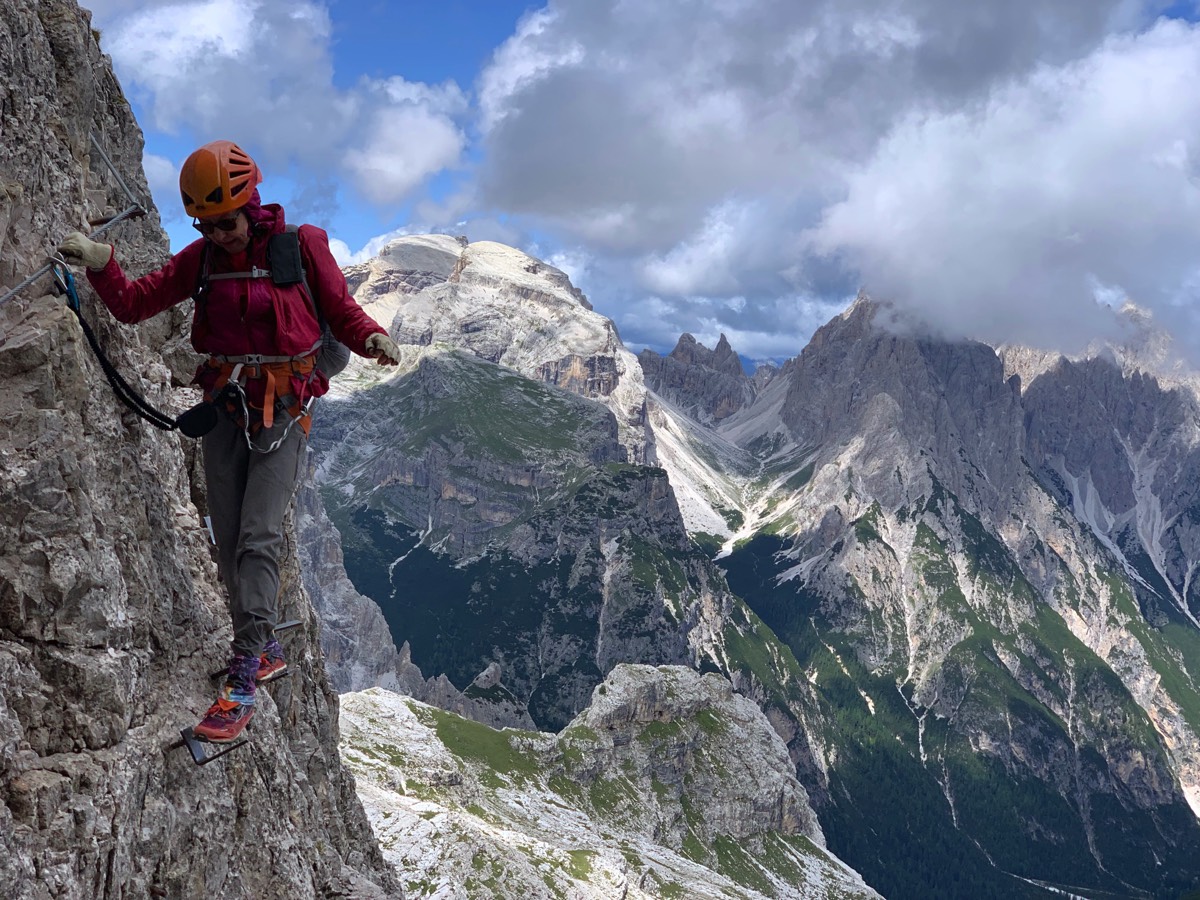
Not our hardest via ferrata but our best photo of the experience (2019).
Health Challenges
The roller coaster ride we’d unwillingly been on this last year continued. Shortly after arriving in Selva on the last weekend in June, I began making urgent stops to poop when out for our 5:30 am walks and we immediately began designing our routes around 2 public toilets. I wondered if I dared attempt an upcoming weekend getaway to Lago di Braies requiring over 4 hours on public transportation both days. My new antihypertensive medication (clonidine) delivered in a week-long patch had been playing havoc with my lower GI tract since I began using it the first week in June, including generating massive amounts of flatulence that would be released without warning several times a day. I assumed this urgent pooping was the latest manifestation of its side effects that I was resigned to living with because it was improving my resistant hypertension while avoiding irritating my upper GI tract.
About when my walks began being structured around toilet stops, I discovered I was having minor hypersensitivity, or skin irritation, reactions from the medicated patch 48 hours after applying it. The halo rash wasn’t severe, but the head-scratcher was that when my skin broke out around the new patch, a similar halo appeared where the previous one had been on the other arm. It seemed totally implausible, but it happened with each week‘s patch change. And on the heels of those nuisance reactions that started 5 weeks after first using the patches, the medication also suddenly wiped out almost all my psychological and physical sexual responses, which was devastating to me. We expected it to be permanent a side effect because this drug acts on the brain and because diminished sexual function is one of its adverse effects. A common problem for people our age for various reasons, but I was having to lift myself out of several hours of depression each day because of profound sadness.
Concurrently, Bill and I were co-listening to an excellent podcast on death and dying which I found comforting but it did add to the melancholy. It was 2 1/2 hours-long and triggered at least double that amount of time of discussion, which was the hope. Like keeping our affairs in order, we needed to ensure we were on the same page with these other stage-of-life realities. So, instead of this being a joyous holiday of rejuvenation, our time in the Dolomites expanded the ways in which we needed to get comfortable with loss. We hoped to be able to fill our days with more joy soon.
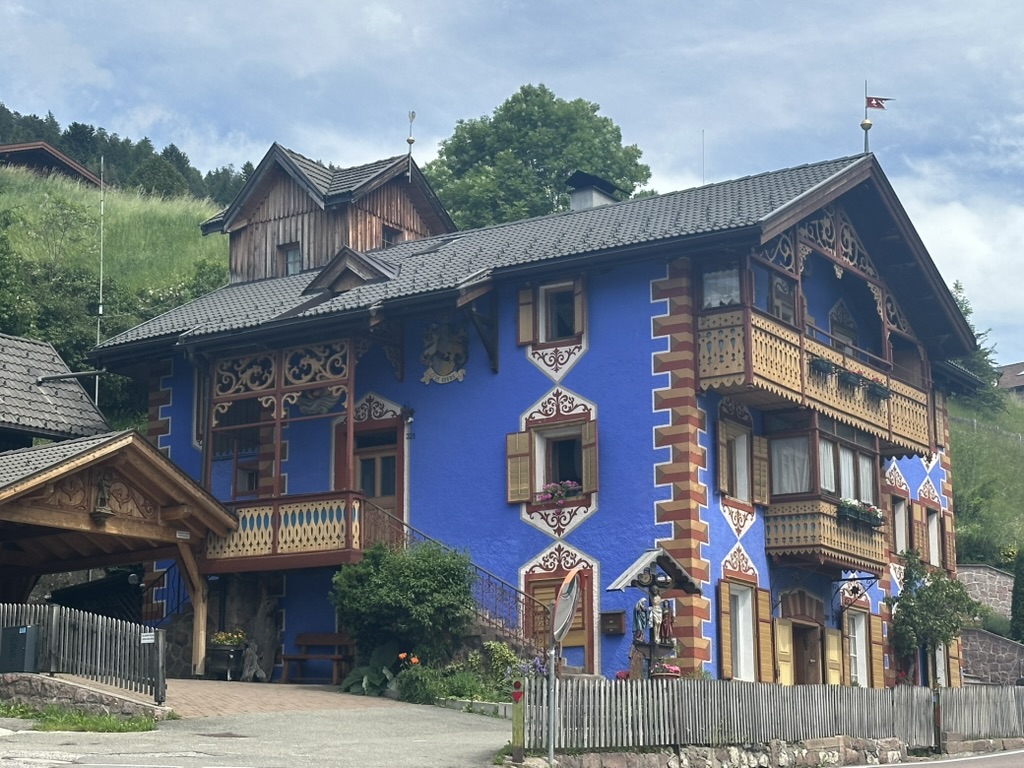
A distinctly “Ortisei” residence.
We guessed that the greater depth and different quality of the last 2 days of depression were a direct effect of the medication on my brain, versus the earlier bouts that were sadness about the side effects. This antihypertensive is different than the others that I can’t tolerate in that it crosses the blood-brain barrier, and it acts on the brain itself. Bizarrely, the drug can cause depression and is also used by psychiatrists to treat difficult depression! We hoped it wouldn’t recur and decided the depression was totally unpredictable, like the other side effects, during my brain and body’s protracted adjustment process to the medication.
Cross Training
Concurrent with my worsening depression that I didn’t want to surrender to, we pulled our e-bikes out of storage only to discover I couldn’t even safely sit on my bike. Here it was mid-July and I’d anticipated an easy transition back to cycling in April in Fruita and neighboring Grand Junction, CO. They offered miles of flat, paved bike routes that I previously was loathed to ride because they were so boring. Our plans for a leisurely recovery month in Fruita had been cancelled for Bill’s urgent 2nd ablation. Now I was faced with much bigger challenge: using a heavy e-bike in a mountain village with nary a flat spot and still being a newbie to e-bikes. However, in hindsight, I doubt that my easily overloaded brain could have handled even the flat, traffic-free riding conditions in Fruita; it would have been too soon.
My first attempt get on the saddle wasn’t pretty. Even with Bill steadying the bike, I could barely do the little hop to lift a foot on to a pedal. I lacked both the coordination and balance do the leg swing to mount and had to step through, and even it was a near thing. Everything was hard. At least I didn’t fall, but it looked like a long road to being able to even sit on my bike.
The next day, I pulled my bike into a narrow hall and spent about 15 minutes practicing as many tiny, stationary maneuvers as I could think of, and it went much better. By the end of my brief session, I could sit in the saddle with both feet on the peddles, one hand on a brake lever, the other on the wall and rock side to side and roll forward and back a few inches. It was huge improvement over the previous day, but it was such a frightening process just to start getting a feel for the bike again, but without going anywhere.
I hoped after 2 more days of indoor sessions on the bike in the safety of the narrow hallway I would be able to ride on the empty streets at 5:30 am. Then Bill saved the day, and perhaps some skin, with his bright idea of dropping the saddle as low as it would go so I could plant my butt in the saddle and simultaneously have both feet on the ground. I clumsily waddled like a 2-year-old but felt like I had the training wheels I longed for, avoiding all the difficulties in getting in a riding position on the bike.
The first day on my “low rider,” I spent 20 minutes doing figure 8’s in a bit of street in front of our apartment building, though had to be alert for a few cars and foot traffic. I practiced balancing, doing turns with 1 shoe skimming the pavement, and forcing my reluctant left arm to stabilize the handlebars on its own, which it could barely do.
The next day, I did laps on a relatively flat multi-use, paved path out of traffic. We were however on the streets to get to and from it, which was nerve wracking, and I almost dumped over at the first intersection with the road. The next 3 days I was mostly on quiet streets and a busier bike path with a half dozen planter box barriers to navigate.
Each day we went out from 1-2 pm, during siesta, because it had suddenly turned cold and damp at 5:30 am. Bill was my safety escort and reported shortcomings in my performance and offered tips. There was little traffic and few pedestrians during that hour but the stressful commotion of the village reawakening promptly drove me off the streets at 2 pm even though the official reopening of businesses wasn’t until 3.
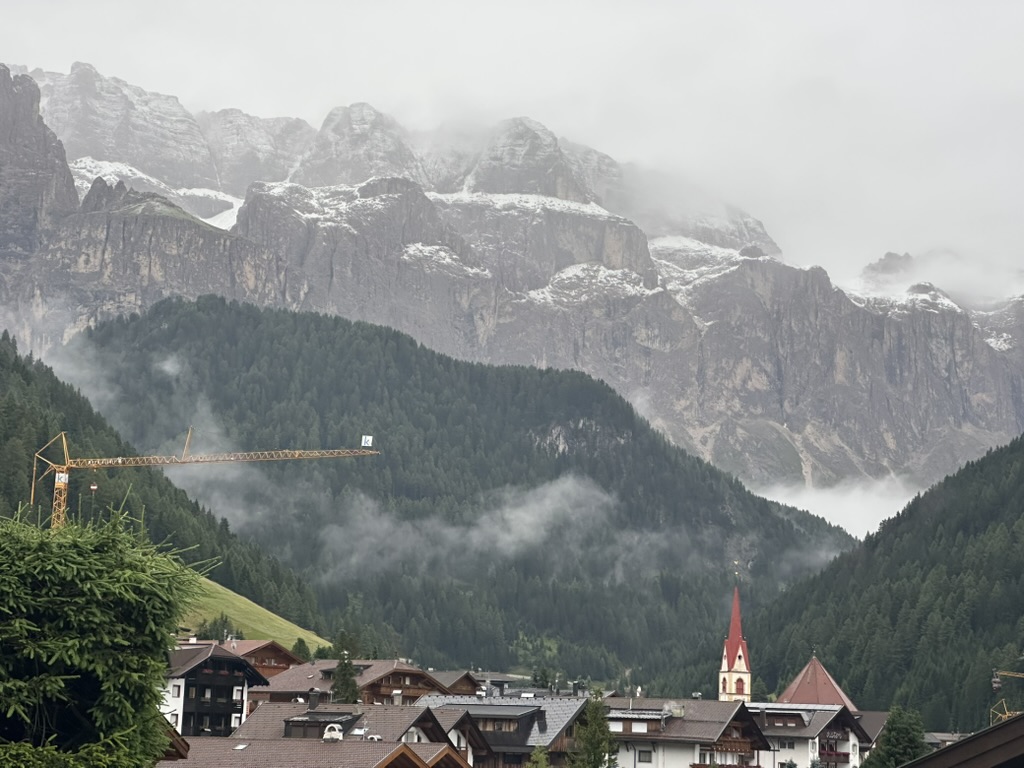
It turned cold with the first of 2 July snowfalls on Gruppo Sella towering above us in Selva.
It may take almost daily riding through the second month of our 2-month stay in Selva to be able to raise my saddle to a comfortable riding position. Being on my bike, any way I could do it, was worth the terror it caused for the cross-training opportunity. Balance and coordination were frustrating, ongoing deficits from my stroke, on the bike and elsewhere, and biking challenged those attributes in novel ways and for minutes at a time instead of seconds, like other activities. Persevering was worth it because cycling is good cross training and walking/hiking were my only other activities. No other sports were possible for me and even 5 miles on an e-bike overloaded my brain.
It was quite bizarre after more than 20 years of cyclotouring and over 75,000 miles of loaded touring in the first 10 years, to be terrified riding a bike. Needing to have the saddle so low was discouraging. A part of me would say it was humiliating and yet the loud voice in my head said, “It is what is.” I was clear that this is who I was now and that other person did not exist.
Remnants of my prior, well-honed skills on the bike were seen and felt, but starting and stopping were not among them. I would need to restore my lost reflexes in charge of quickly planting the correct foot on the pavement for an emergency stop on a slope in order to be safe in traffic; now it was my dominant leg, the leg that was also unaffected by the stroke, that always responded to the call for action. Without that critical reflex in play, I was at risk of falling sideways when abruptly stopping.
The amusing part of being on the long road back to safely cycling was that getting my bike in and out of the ski deposit storage room was the single most effective PT activity I did at the time. It’s a small room with an extremely heavy fire door. I simultaneously wedged the door open by pushing on it with my back and butt while inching my feet apart wider and wider and wheeling my 45 pound e-bike through the doorway. Outside there was a spongy drainage mat that was soft enough to throw off my precarious balance, especially with my cleated shoes. Each day I was a little better at the painfully slow maneuver that required several minutes. Bill stood ready to catch me or the bike should I start to tip over; otherwise, he respected my request to let me get both bikes in and out the doorway alone. We both knew how hard it was for him not to rescue me because it was a really pitiful, uncoordinated sight but it clearly paid off big time. The efforting improved my coordination, especially in my lateral stability, which had been hard to stimulate. It was like I lost some lateral core coordination, and this was such a demanding, full-body movement against the compressive forces from the weight of the door and the weight of bike, that my brain slowly learned how to sequence the gyrations that were once smooth and effortless.
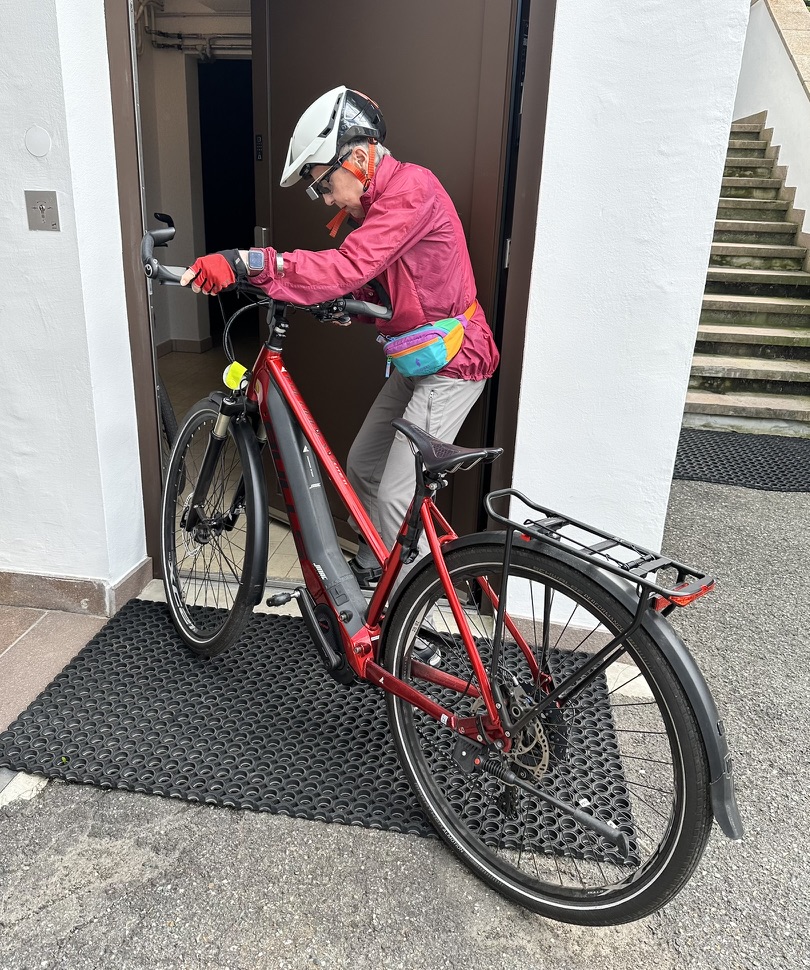
Barb’s post-stroke balance & coordination deficits made wrestling her 45 lb bike while leveraging the heavy door open an almost insurmountable task.
Testing My Travel Durability
My string of 5 days frazzling my nerves on my e-bike while struggling with escalating depression was interrupted by an overnight get-away. The demanding trip required taking 8 buses/trains for over 4 hours each way to and from Villabassa/Niederdorf near Lago di Braies for a meet-up at 8 am on the second morning.
A friend of a friend brought me a 60 g tube of Zoryve, a newer topical anti-inflammatory, she carried with her when she flew from Palm Springs to Italy a few days before. We carried the combined weight in our packs of over 30 pounds for the journey, mostly for their “thank you” gift bag of hiker food and food for our 4 meals because the markets in Niederdorf were only open until noon on our arrival day.
We carried the picnic gift bag of a spilt of wine, cheese, a couple of meats, dense bread, a corkscrew, a knife and a few other goodies for their trouble. I was relieved when she said the whole undertaking had been: “A fun adventure” because I had worked hard to make the intricately planned meet-up as effortless as possible for them.
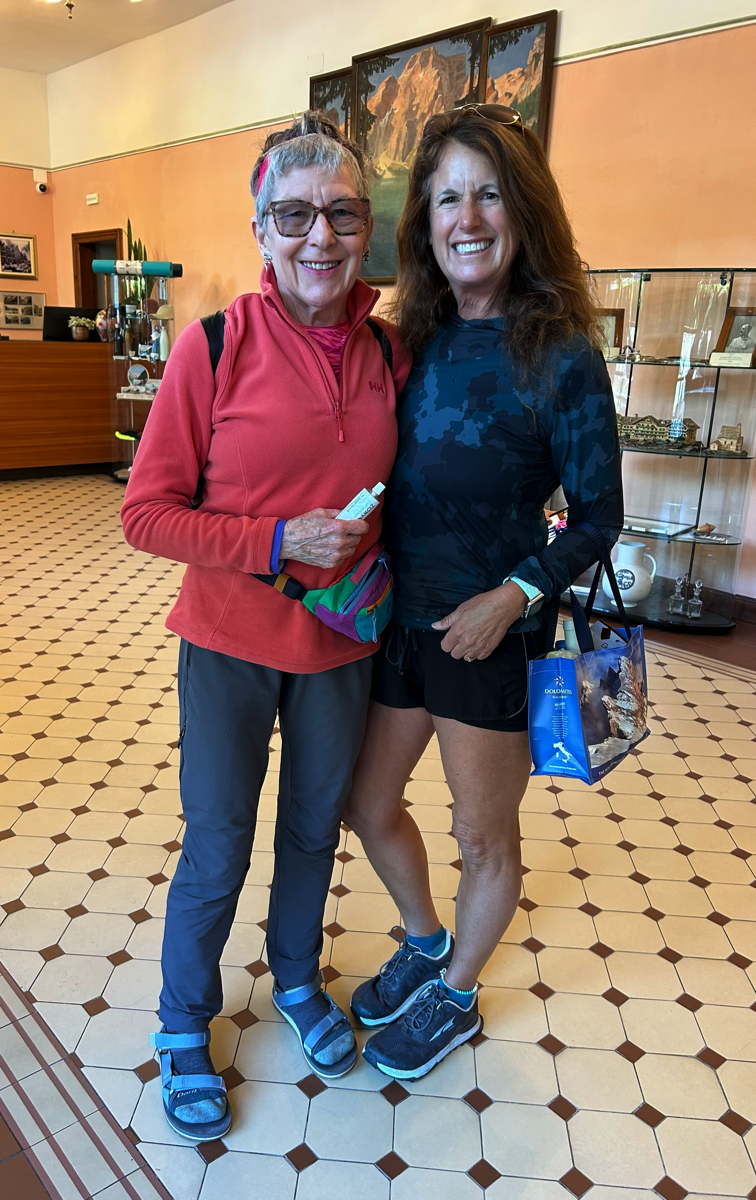
The culmination of a month of meticulous planning: the exchange.
Bill spent hours patching together our transportation itinerary through construction closures and helping our courier solve some of her transportation problems. Through it all, Bill kept focused on the pleasure of the hour-long stroll around the lake we would enjoy after the meet-up. Unfortunately, the formerly idllic lake had been overrun with tourists since it was “discovered” in 2020, necessitating buying two 13 EU ($15) round trip tickets for a 20-minute bus ride to the lake—a ride that normally would have been free for us.
The lake’s setting was as beautiful as advertised and we also enjoyed seeing their “Alta Via 1” trailhead at the lake where they launched for their classic, 7-night trek. Only a few hours before the brief rendezvous, we had learned of the lightning-started fire that devastated most of the lodging at the Grand Canyon’s North Rim. All 4 of us had previously hiked between the rims, had reservations again for the fall, and found it cathartic to share our tears with others who were also grieving the deeply felt loss.
The carefully planned and implemented meet-up was a complete success and we enjoyed seeing a corner of the Alps we had missed, but I was disappointed my travel worthiness hadn’t appreciably improved in the 5 weeks since we flew to Europe. All the chaotic visual stimulation of the first morning’s travel fried my brain, and I sat for the better part of 4 hours that afternoon in a cold park kiosk rather than joining Bill in doing the planned walk until we were allowed into our room at 5 pm. Darn. My brain was clearly improving, and I was more comfortable than I had been for 10 months, but only if I sequestered myself in a narrow slice of my former world.
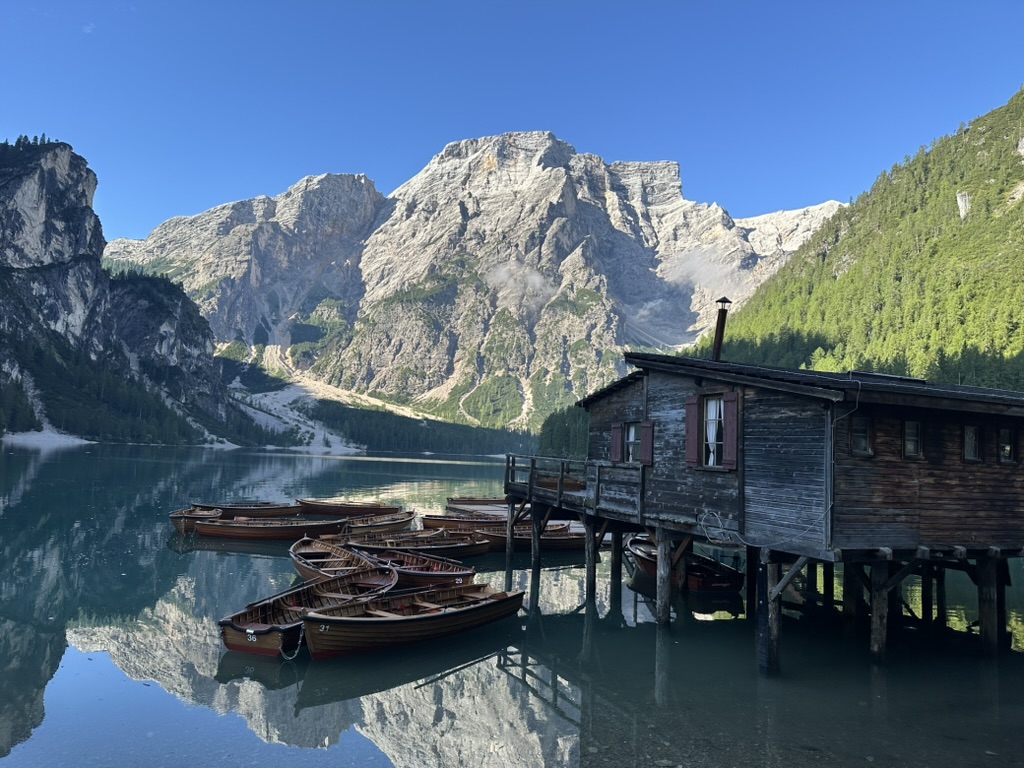
Lago di Braies in the next valley in the Italian Dolomites.
Backstories: The Manosphere
Our string of challenges in June and early July had been interlaced with shocking instances of male bullying, including when getting my hands on the Zoryve cream, and Bill suspected we were encountering “manosphere” rage. The manosphere was something we heard about during the previous presidential election. With raised eyebrows and cocked heads, we read the occasional article justifying this new wave of misogyny. We listened to white guys and black guys link the manosphere with their support of Trump and got no further in our understanding than “Really?” We accepted that it was a thing, but it seemed so hollow and nothing more than a thinly veiled way to bolster some people at the expense of others.
Bill proposed the manosphere was fueling 2 of the 3 incidents in 3 weeks in which a man began riffing on me in a hostile and threatening manner for no apparent reason. A partial plexiglass shield left over from covid helped me feel physically safe in one instance; 9 time zones across the Atlantic on a phone call was a comforting barrier for the other, though I’m sure the man thought I was local and he’d soon have the satisfaction of a face-off. Both men aggressively told me to get out of their space and literally where to go, which was from his purported customer service desk to that of another company in the first instance, and across the street to another pharmacy in the other instance. They were both dead wrong in their assessment: in their face was exactly where I needed to be and where I would remain.
I barely had enough of my usually considerable resources to push back against these bullies when dealing with both. All I had to do was remain standing (actually lean against his counter) in front of the Lufthansa clerk with my frail, stroke-damaged brain that was overloaded and jet lagged, but I knew I was fit for battle with him. I was already furious about our ignored, delayed luggage and he further fortified my resolve with his rapid-fire script, raised voice, and strident arm gesture indicating exactly where our exit from his space would lead. I knew that despite his threatening and unprofessional manner, I was on the right side of the issue and intuitively knew I could outlast him. I was shocked he couldn’t feel he was careening down the path to looking the fool, which is where he landed. His inexperience was on full display, and we were both stunned that such a young man was already housing so much overflowing anger.
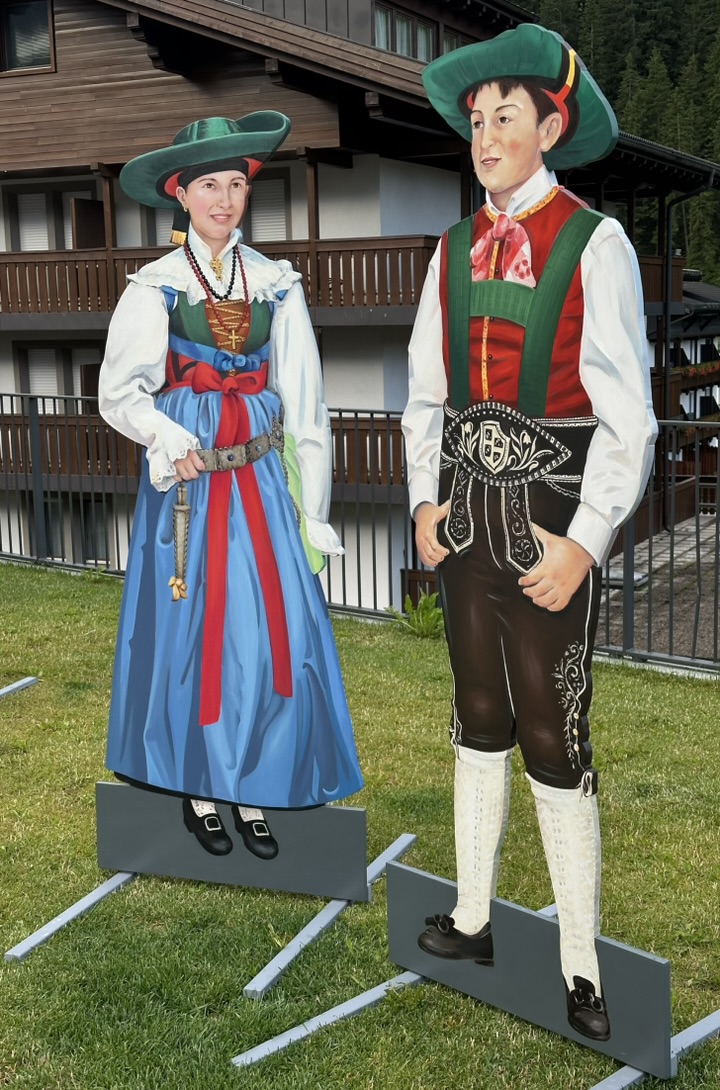
Notice the dagger hanging from the woman’s waist: a common accessory for women of all ages & all times, whether working at home or at celebrations.
These guys were mean, deceptive, defensive, and wrong and yet they were probably surprised that repeating their playbooks had them repeatedly being losers. It reminded me of the pre-Me Too times when politicians were denying their inappropriate sexual activities and were delusional enough to think they wouldn’t get caught. So much for progress!
I deeply lamented having had these battles while they unfolded because they were so consumptive of my very limited personal resources, but I wanted my stuff: our 4 pieces of neglected luggage and a desperately needed topical eczema prescription medication for me. These men seemed to be spontaneously and arbitrarily blocking my access to what was undeniably mine for their sport and yet were woefully unskilled before an old woman with a lifetime of experience in dealing with bullies.
The resolution of each problem occurred over the course of 4 days and swallowed hours of our time pursuing multiple avenues, and over 2 hours of international phone minutes for the pharmacy issue. In both instances, getting past these 2 men was the final stage in getting our goods from another person quite quickly after they were toppled. They were both weak players in the silly power games of their choosing.
The 3rd confrontation had been with a physician in early June and his older age and greater stature seemed to have disqualified his behavior from the receiving the manosphere label. I attributed his condescending, confrontational style to old-fashioned misogyny and power tripping but it had been an unfortunate set-up to the next 2 manosphere-fueled incidents. When I see him for a follow-up visit in the fall, I’ll shut-up and bow to his authority hoping he’ll back-off with the insults.
Backstories: Add Another Zero
Deciding to pay almost $1000 for a small tube of medication, for the Zoryve, had required some reflection. It seemed it wasn’t long ago that we consciously shifted our comfortable price point for novel or unexpected things from the “one zero” column, as in from $10 to $99, to deciding we needed to add another zero and be at ease when paying over $100 for such things. There was a time when modest overnight lodging Europe could be had for $50 a night and RV parks in the States were less than that, then suddenly, prices were increasingly crossing the $100 line.
In 2025, we were stunned to reconcile ourselves to adding yet another zero for goods and services, crossing the $1000 line. In February, we convulsed with the thought of paying over a $1000 a day for a 6-hour day of traumatic brain injury therapy for me. The personal-pay treatments seemed implausible but considering my constant misery and the absence of any other help, I took the plunge. We both viewed the treatment model as “smoke and mirrors,” but Bill said he would support my decision, so off I went in February and again in May.
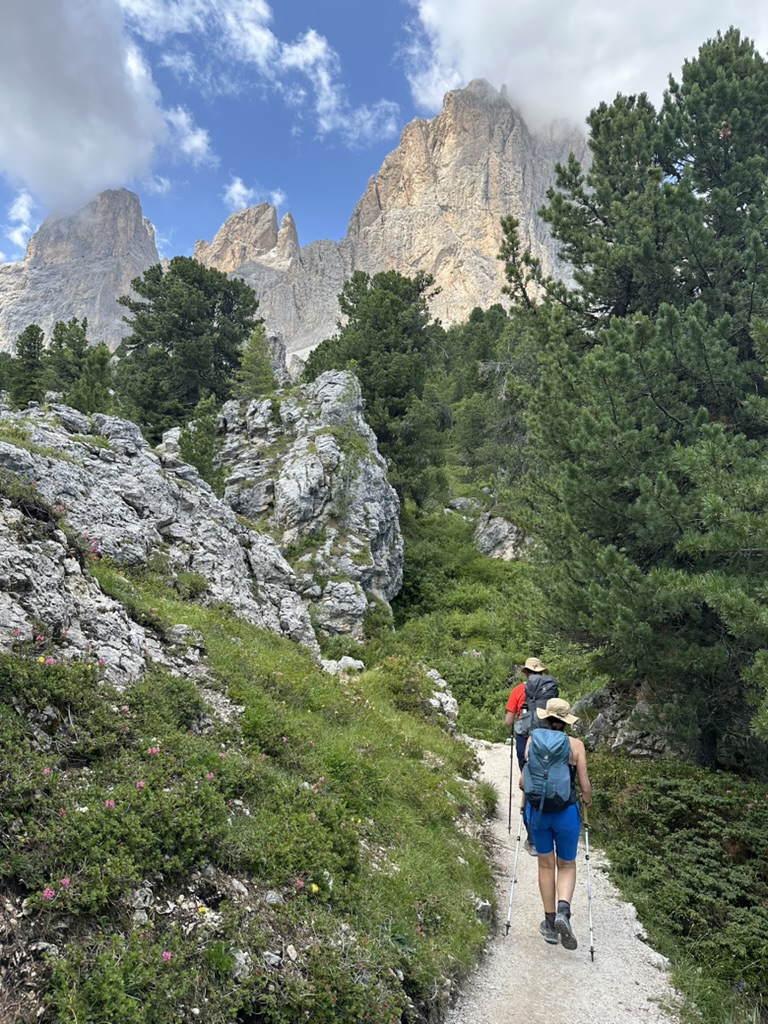
The trail through the “City of Stone” rock fall formation at Passo Sella.
Time would tell how voracious of a consumer I would be of the product, but after exhausting the 1st of my 3, 15-gram tubes in 10 days, I switched to treating my legs every other day with the product while hoping to have the friend of a friend bring me a larger tube with double the concentration. And of course, our new, non-OTC, hearing aids fell into that “extra zero” category as well.
Fortunately, for several years before our capacity to “add another zero” was challenged, we had chimed: “When we get old, we will freely spend our savings to remedy the effects of aging if we can.” We had been coaching ourselves so as to be prepared to abruptly switch from a lifetime of frugality to buying whatever relief or enhanced quality of life we could have and 2025 had been that year. We still winched and made ugly faces when these “opportunities” arose but at least we repeatedly pressed the “Buy” buttons.
Hitting It Hard
While the expanses of my damaged leg skin slowly healed from having an ample supply of Zoryve, I experienced a 2nd “upward spiral,” or a synergy, with my stroke recovery at the end of July: improving stimulated more improvement and the more capable I became, the more daring and greedy I was for more of the old me, and the better I felt because of it.
I hadn’t done even the slightest jog in 2 ½ years because of my painful lumbar spine issues that immobilized me on Christmas Day of ’22 but one day in late July of this year, I began slowly shuffling/jogging down a gentle, gravel trail for 2 sessions of 3 minutes each because the time felt right. A few days later, I consolidated my new effort into a single 5-minute jog and on another day, it became 8 minutes. Like so many of my rehab efforts, what was a precious victory for me probably looked pitiful to those who saw me shuffle by them. I could imagine them saying “Why bother with so little?”
My shuffling pace was slightly faster than a good, post-stroke walking pace for me and made many muscles and joints from my waist to my toes a little sore. I was delighted with the bit of soreness, which I took as a sign that I’d found the sweet spot, the ideal level of intensity with my latest PT undertaking. The best way to overcome my considerable deficits was to challenge my brain and body in as many ways as possible and shuffling was another tool in my kit. Bill had recently noted a faulty movement pattern in my left foot when doing an exercise and shuffling seemed a dandy place to put my new foot awareness to work.
When I asked my Neuro coach about jogging in May, he recommended against it because of the brain discomfort it would trigger, but I had longed for a way to add variety to the 50 miles a week of slow rehab walking I was doing. The trot wasn’t for the CV exercise but for the challenges from the novel movement patterns. I was already having more brain “symptoms” from recently over-doing my eye exercises, so I was willing to let my muscles be annoyed as well.
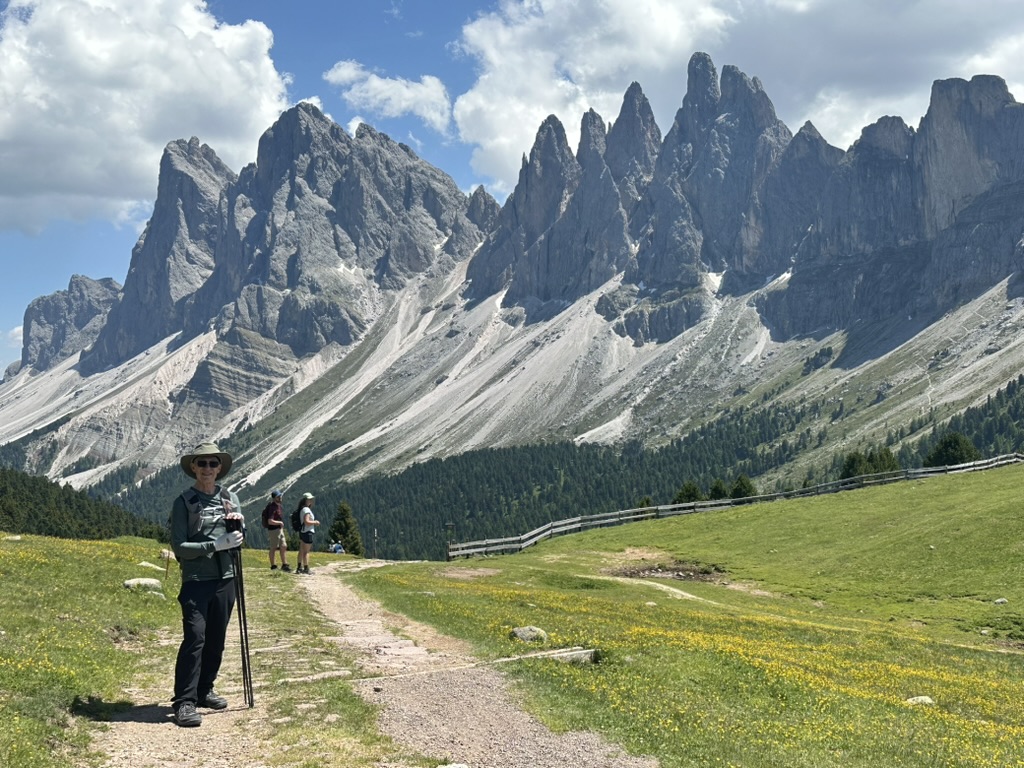
Bill returning from the favorite Brogles Hut hike.
In the strength department, I surprised myself on July 20th by holding a dead hang for 2 1/2 minutes the first time since the very first time I achieved that duration on August 20th, 2024, a couple of weeks before my stroke. I was especially pleased with my trophy hang after reading that ninety seconds is considered the target for a woman of any age. At least for the time being, it was a one-off, but something to build on.
By the end of July, we were both refining our fitness training. For me, that meant slowly hiking/walking 8 miles almost every day and averaging 1000’ of elevation gain per day. Those targets were equivalent to my averages in prior years but without doing any single hikes in the 8-to-20-mile range like we’d done all previous summers. I also added climbing indoor stairs 2 at a time, an old quad strengthening favorite, once a day some days. Seemingly out of nowhere, access I’d been denied to my mobility and flexibility for 10 months was being granted in small but comforting ways. We hypothesized that my brain had been limiting my mobility (stiffening me) to stabilize my poor balance.
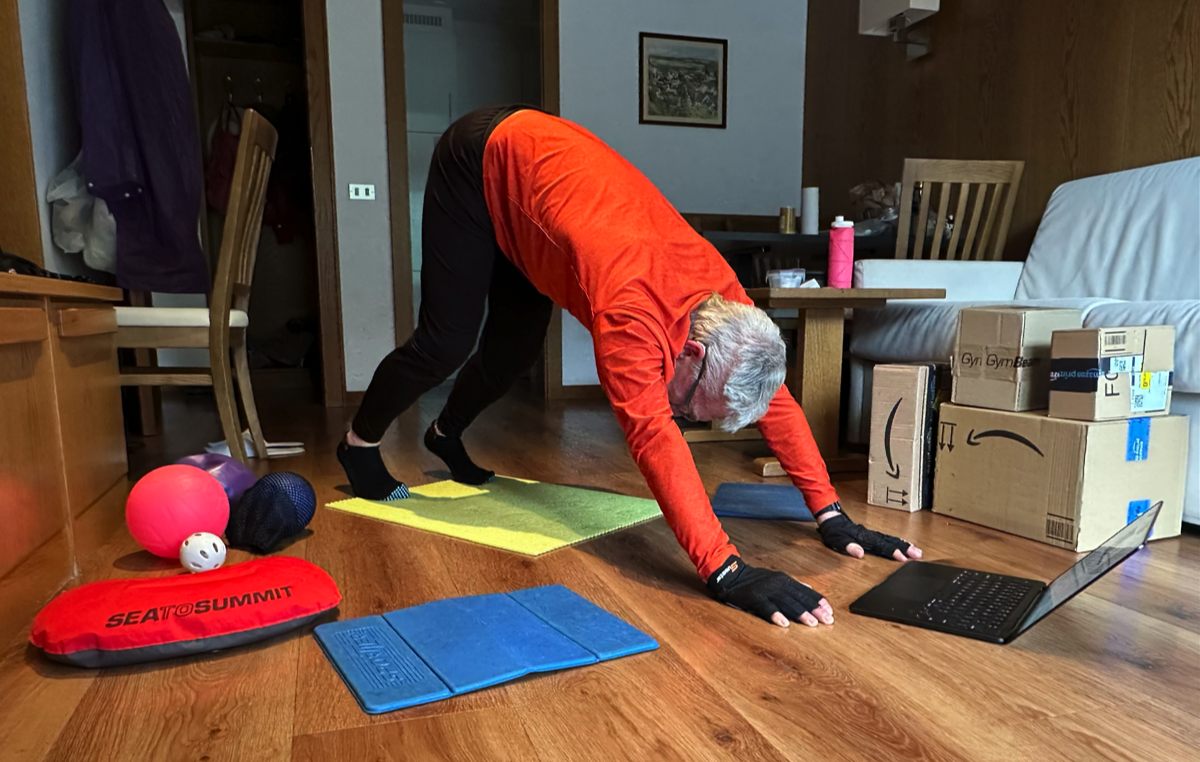
Bill working hard without annoying his ailing heart.
Bill’s #1 goal for the summer of ’25 was to stay out of the Italian ER’s, which he visited twice last summer. In July, he wisely further adapted to his body’s wishes as they became increasingly clear. He was counting the days until his leadless pacemaker implant in late September and was expecting to feel much better with its support once he recovered from the procedure.
Looking Ahead to August
At the end of July, we were cautiously optimistic about having a satisfying and an uneventful second month in Selva and the Dolomites. More healing, less drama was the hope. After the initial heat wave in June, we’d had seasonable but unfamiliar cold, damp weather, which suited us just fine. And probably partly coincidentally, we’d also enjoyed many days of clean air. We were crossing our fingers for more of the same until our return to the US in early September.
Parting Thought
Stephanie Case, 42-year-old ultramarathoner who breastfed her 6-month-old 3 times during a 62 mile race, and won, told CCN on June 19, 2025:
“Becoming a mom, it’s one of the most physical and emotional transformations you can go through in your entire life. And so if there are things that you can hold on to – for me, it’s running – that kind of remind you that everything that has changed, there are some things that remain constant, there are some parts of your identity that you haven’t lost.”
I took her lovely sentiment and applied it to my dramatically changed life:
“Becoming old, it’s one of the most physical and emotional transformations you can go through in your entire life. And so if there are things that you can hold on to – for me, it’s hiking – that kind of remind you that everything that has changed, there are some things that remain constant, there are some parts of your identity that you haven’t lost.”