
DOLOMITES II: August 2025
Coasting
A Welcome Calm
August 2025 was the month of calm we had been desperate to experience for over a year. The health crises, traumatic intrusions, and blindsiding events ground to a halt and ordinary experiences were overlaid on our pleasure of being in an extraordinary place, the Italian Dolomites.
We did ordinary things, like becoming short distance walkers instead of high mileage hikers, in deference to our health issues. Finally, we shed the roles of crisis managers and of continuously over-exercising our coping skills and turned our attention to the mundane, like our daily grocery shopping. For a while, we could just be.
Shedding the Excess
One afternoon I sat on the sunlit, carpeted floor in front of the large patio door onto the balcony of our Selva apartment looking at the magnificent Sassolungo peak that we’d again be in the presence of at Passo Sella. It was a fitting setting for saying “Good-bye” to our via ferrata climbing gear. We’d decided weeks ago that throwing it in the trash was the right thing to do. Even though it was of high quality and lightly used, it was purchased in 2014 and for safety reasons, no one should use it again.
Coasting
A Welcome Calm
August 2025 was the month of calm we had been desperate to experience for over a year. The health crises, traumatic intrusions, and blindsiding events ground to a halt and ordinary experiences were overlaid on our pleasure of being in an extraordinary place, the Italian Dolomites.
We did ordinary things, like becoming short distance walkers instead of high mileage hikers, in deference to our health issues. Finally, we shed the roles of crisis managers and of continuously over-exercising our coping skills and turned our attention to the mundane, like our daily grocery shopping. For a while, we could just be.
Shedding the Excess
One afternoon I sat on the sunlit, carpeted floor in front of the large patio door onto the balcony of our Selva apartment looking at the magnificent Sassolungo peak that we’d again be in the presence of at Passo Sella. It was a fitting setting for saying “Good-bye” to our via ferrata climbing gear. We’d decided weeks ago that throwing it in the trash was the right thing to do. Even though it was of high quality and lightly used, it was purchased in 2014 and for safety reasons, no one should use it again.
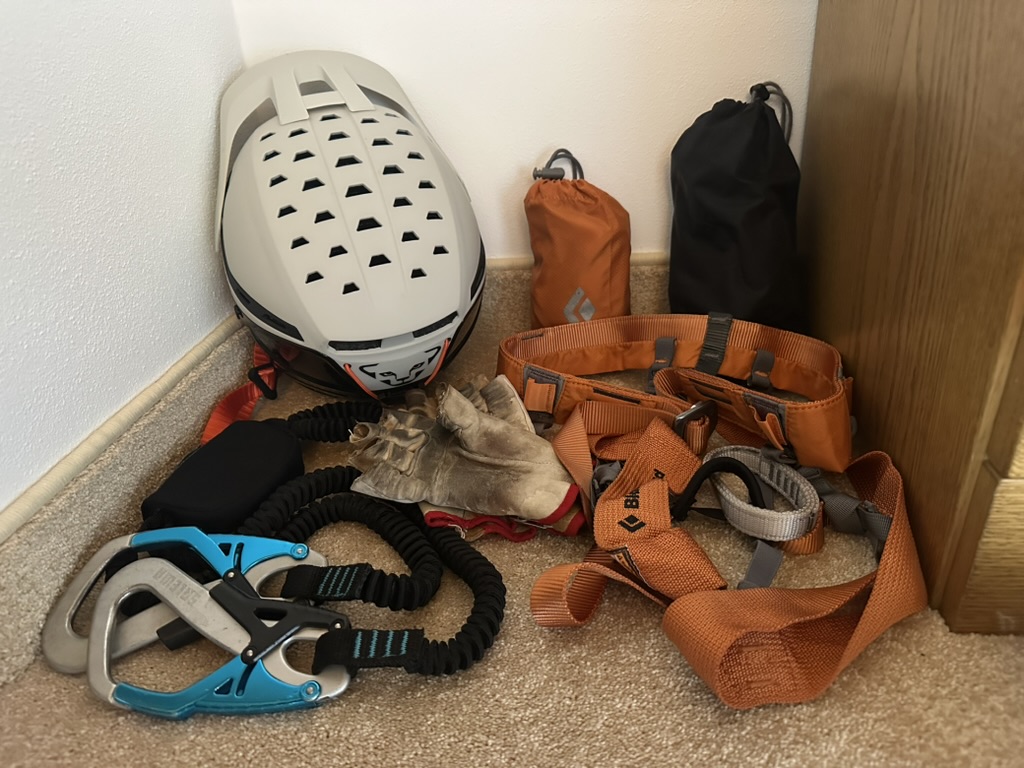
Honoring a piece of our history together.
I had spread my set on the floor next to my bedside for a couple of weeks to initiate the long good-bye process I sometimes need when parting with objects. I’d planned to pitch it in 10 days, when we moved to Passo Sella for a week, but poor air quality made this an unscheduled “in” day and the perfect day to complete this sad chore. I would take the planned photo for our album to mark this bit of our history, bag the gear, and take it out with the day’s trash. But it turned out to be more complicated.
I discovered I needed to sit with it: to hold it to my heart; sniff the $3, well-worn cowhide gloves that had spared my hands from the poke of frayed wires; appreciate the smooth action, easy-on-our-hands carabiners by opening and closing them; and let my fingers linger on the many textures of the orange harnesses we were so careful to suit-up with. The few seconds anticipated to bag the gear stretched into minutes and then more minutes.
There was more grieving to do. I pondered my attachment to such objects like they were my pets. I needed to say “good-bye” even if they didn’t. I needed closure. The grief wasn’t about my stroke taking away my ability to ever use such gear again, it was about separating from stuff and having it permanently leave my life. I now needed the gear to “cure” in its new configuration: out of its tidy bags and heaped. I couldn’t just stuff it in a garbage sack and look away, walk away; I needed to send it off in stages.
I flashed on the thought that this process wasn’t just what happens to stuff, but what will happen to me: one day would be my last day as well, like for all things and all people. “True, but let’s not go there now” was the instruction from my head. “One thing at a time and now is the time to part with my treasured but obsolete and possibly unsafe gear, no matter the pain in separating.” And then it would be well-grieved and moved on and I would have the peace from proper closure on this part of my life.
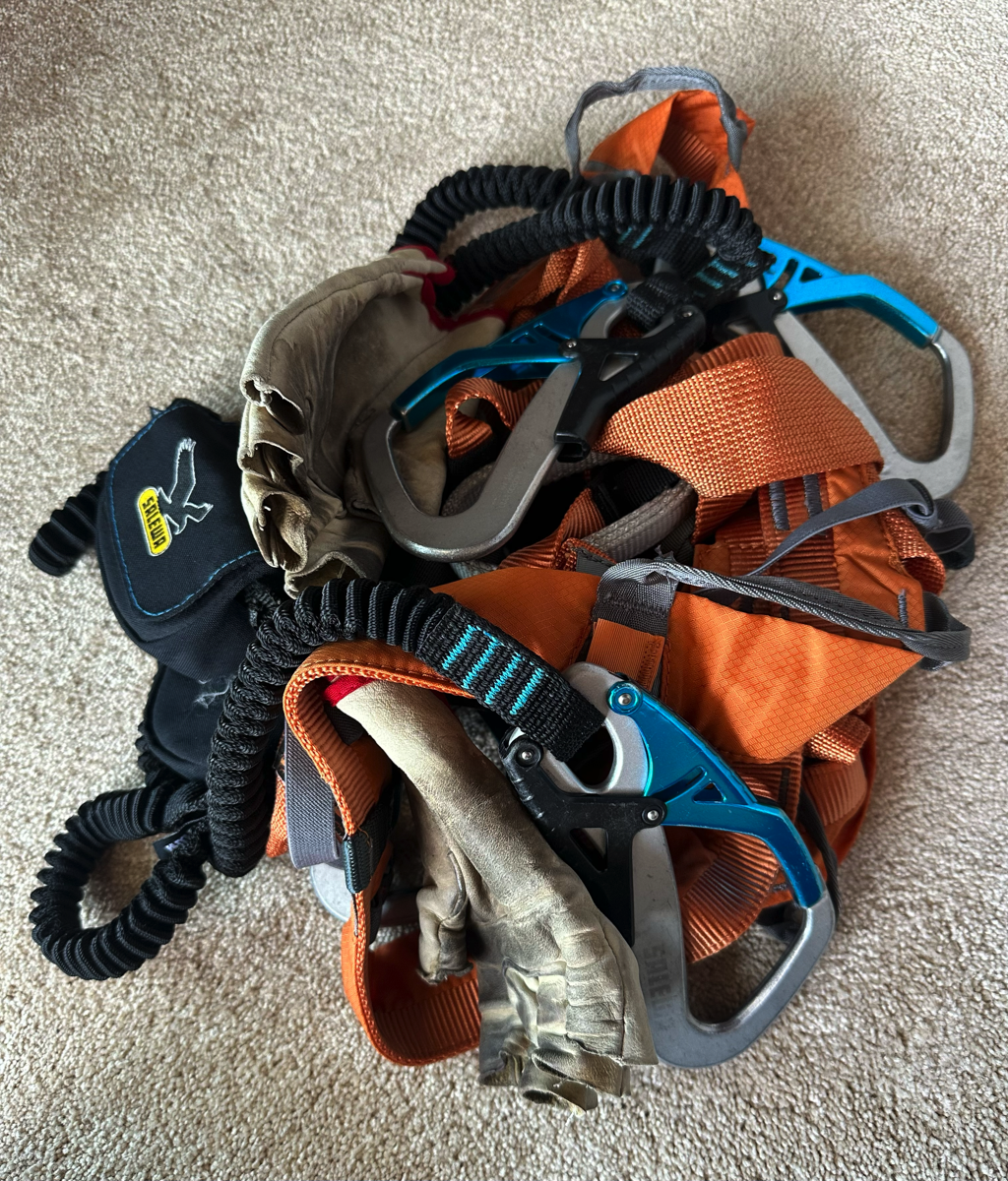
Next stop: the dumpster.
Bill shot-up the learning curve for obtaining prescription products in Italy, both with and without a prescription, when he began taking the very expensive anticoagulant, Eliquis last summer. We’d learned over the years when abroad that often: “If you have one, you can get one” whether the one you’ve got was sourced in the US or Italy. Last summer, Bill learned there was even more flexibility in that some pharmacists were very generous in allowing one to essentially refill a prescription which had no refills. A year ago, Bill was scooping up Eliquis well below US prices to cover him until he saw his doctor in the States.
In mid-August this year, Bill encountered the dark side of Italian business in the mountains, in an autonomous region, a side of the culture that we’d only experience in southern Italy: he was ripped-off by a pharmacist.
Bill had just enough Eliquis to get home in a few weeks, but given it’s a high-stakes medication for him, he wanted a little buffer. Like we had learned to do, he showed the local pharmacist his bottle of prescription-only Eliquis, the pharmacist went into the back, and returned with the boxed blister packs of the medication.
Once at the apartment, he opened the box and discovered he had been shorted. It should have contained 3 strips of 20 tablets, for a total of 60 tablets but had one strip of 14 tablets and one strip of 20. Someone had been shuffling strips of Eliquis between the packages intended for patients with deep vein thrombosis and for patients with Afib, like him. They were all 5 milligram tablets, but packaged for being taken once a day for 28 days and twice a day for 30 days depending upon the patient’s condition.
Bill was still fuming at the discovery when I came into the room. Especially as travelers, we tend to take the path of least resistance and to avoid confrontation, so Bill was tempted to just eat the loss. He guessed that this was a well-practiced scam that the pharmacist only used on foreigners. Confronting the pharmacist could have devolved into a “he said/she said” along the lines of Bill misplaced the 3rd strip of tablets except strips had been shuffled between boxes with different treatment regimes-something that only could have occurred before Bill received the box.
Not surprisingly, the pharmacist shrugged it off when Bill confronted him about the “mistake” an hour after discovering it. The pharmacist apologized but didn’t seem surprised. We however were shocked and deeply disappointed. South Tyrol, where we stay, is one of the 5 autonomous regions in Italy that have special privileges, including contributing less money to the federal government, and it shows here. The mafia siphons the extra funds off in Sicily but in the north, a visible amount of it goes to infrastructure and cultural support. Part of the pleasure for us in being in South Tyrol is that it is well funded, making it a cheery place to be. We regretted having our idyllic impressions tarnished by this deliberate, predatory behavior.
The experience brought to mind deeply buried memories of unkind experiences in Italy. In Sicily, we came back to our room in a small hotel one day to discover that someone (probably the owner) had taken a bite out of our wrapped chocolate bar. In southern Italy, in Matera, the host refused to provide toilet paper in our room and when we checked out, he announced he was charging us 5 Euros to store our bikes because he didn’t have change to give us. And generally, we abandoned open air markets in favor of supermarkets where we knew we were paying the same prices as everyone else. I would have preferred not to have those memories triggered in our idyllic mountains but we would be less trusting in the future.
Snake!
In 2011, we switched from cyclotouring abroad 9 months of the year like we had done for the previous 10 years, to hiking in the US 9 months of the year, and one of the new, necessary skill sets was being smarter about snakes. I applied myself and, in the spring of 2012, posted my personal manual on our website about venomous snakes, particularly rattlesnakes. Moving up that steep learning curve still serves us well and was huge in helping us become comfortable sharing the trail with snakes, knowing we are intruders on their land.
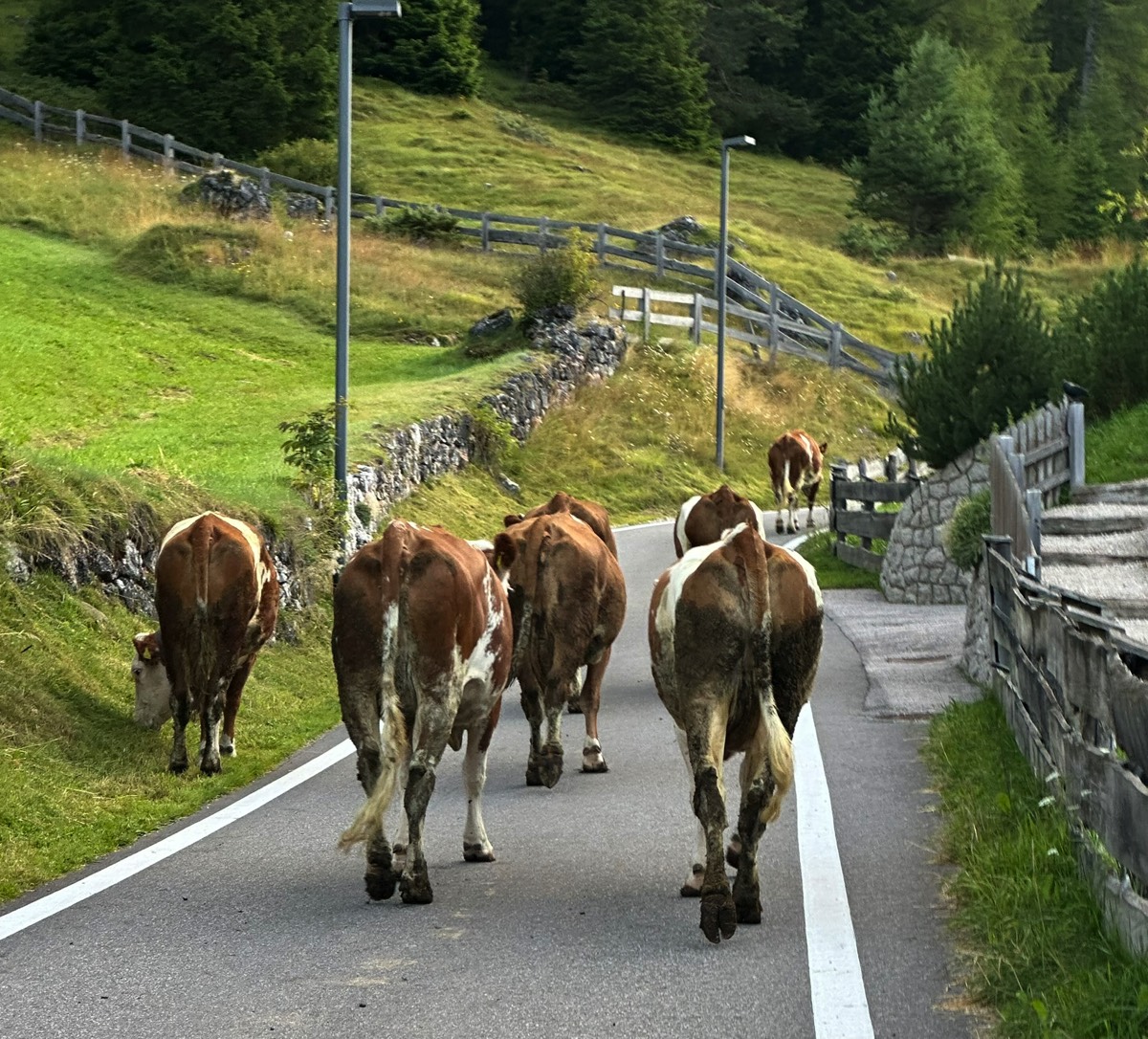
Heading to Val Lunga with the cows.
On a cool but warming mid-August day, I was doing my almost daily rehab walk up Val Lunga, a tourist hot-spot in our Italian village, Selva. The first mile or so of the noisy grit trail was often swamped with tourists staring to the top of the steep cliff walls and musing at the sight of the grazing cows while the high-mileage hikers doing the long distance Alta Via 2 (high trail 2) briskly marched through the crowds. I was half way to my turnaround point on my 8-mile hike and eyeing the group of 6 ahead of me at a constricted bit of trail, planning how to pass them, when a woman in red abruptly stopped and shouted with outstretched arms to warn her group to immediately stop. We all heeded her warning and stopped in our tracks.
Given the venomous vipers rarely seen in Val Lunga are quite shy, I edged around the frozen group on one side of the trail to get a glimpse in the unlikely case that the snake was still there. Unlike rattlesnakes, which are notorious for holding ground, we had learned through personal experience in the Alps that vipers are quick to skedaddle.
When I had advanced enough to peek around the woman in red, I was flabbergasted to not see a snake but that my dormant snake alert reflex had been instantly activated by the sighting of cow poop on the trail!
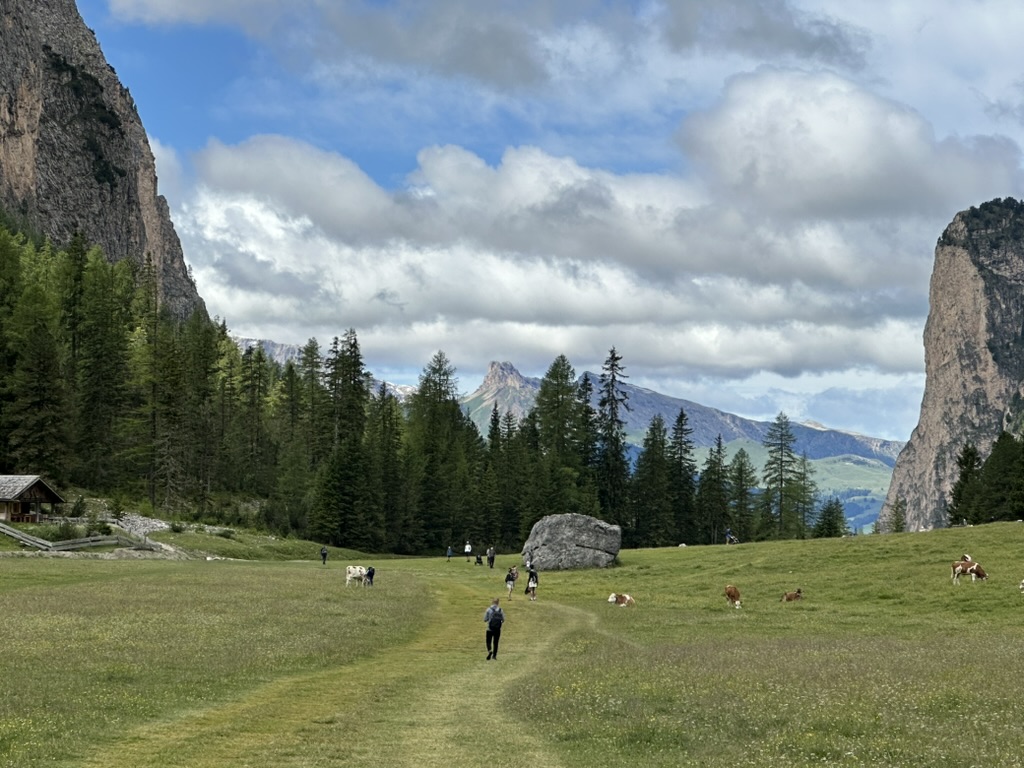
Val Lunga
The little event reminded me of a lesson learned in anticipation of becoming international cyclotourists: “The world is covered by a thin veneer of poop.” The one liner brought the house down at the travel medicine conference when delivered by an epidemiologist. His well-chosen words worked: his words had stuck with me for over 25 years and made me more at ease in situations like this one in which the veneer was a little more visible.
Stress: Bill’s Cautionary Tale
A certain amount of stress in life is useful to provide the motivation we need to get through each day, but it’s all about where you draw the line between too little and too much. Bill learned the hard way that for decades, he propelled himself with an excess of stress. Journeying through time with Bill’s examination of his relationship to stress may give you insights as to where you may benefit from redrawing your own line:
It’s 1AM. I’m lying here in bed, unable to sleep. What is going through my mind keeping me awake? Barb suggested I write a piece for the webpage about my understanding of the origins of my decades-in-the-making, complex heart condition: basically atrial fibrillation with sinus node dysfunction. I don’t like to write and it’s making me anxious.
I have an historical view of myself as an uninteresting writer. It’s the result of not having access to my emotions during those formative years when we learn to think and write creatively. You know, when you had to stand up in grade school and talk about what you did over the weekend, or write an essay about your favorite sport. More on my emotional distancing issue later, but the important realization is that I’m anxious and it’s keeping me from sleeping.
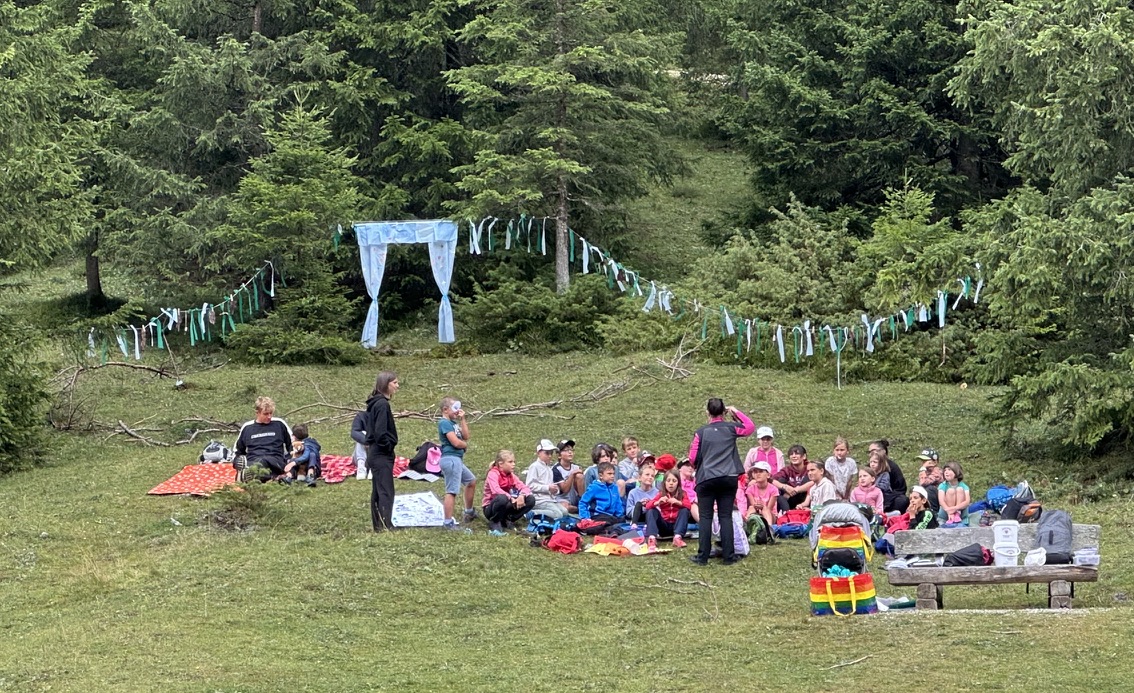
Young Bill would have been paralyzed by the thought having to perform with this children’s group in Val Lunga.
The stress was constant, both from lack of sleep and because my goals were unrealistic. I wanted to be a doctor, and I wanted to get to medical school in 3 years, not 4. I had to get excellent grades but I was a slow reader and a terrible procrastinator. It was an endless cycle of anxiety, leading to stress, leading to poor sleep, and round and round it would go, through college, medical school, my resident training, and into my professional life. At each stage it was fueled by different circumstances, but the result was always the same.
My childhood was stressful too, but for different reasons. My mother was depressed and extraordinarily anxious. She dealt with these issues by minimizing the emotional content of her life. Expression of emotion was discouraged, even punished, not physically, but with criticism and withholding of love. Disagreements between my parents were expressly forbidden. In fact, the entire family was expected to have the same values, desires and beliefs as my mother.
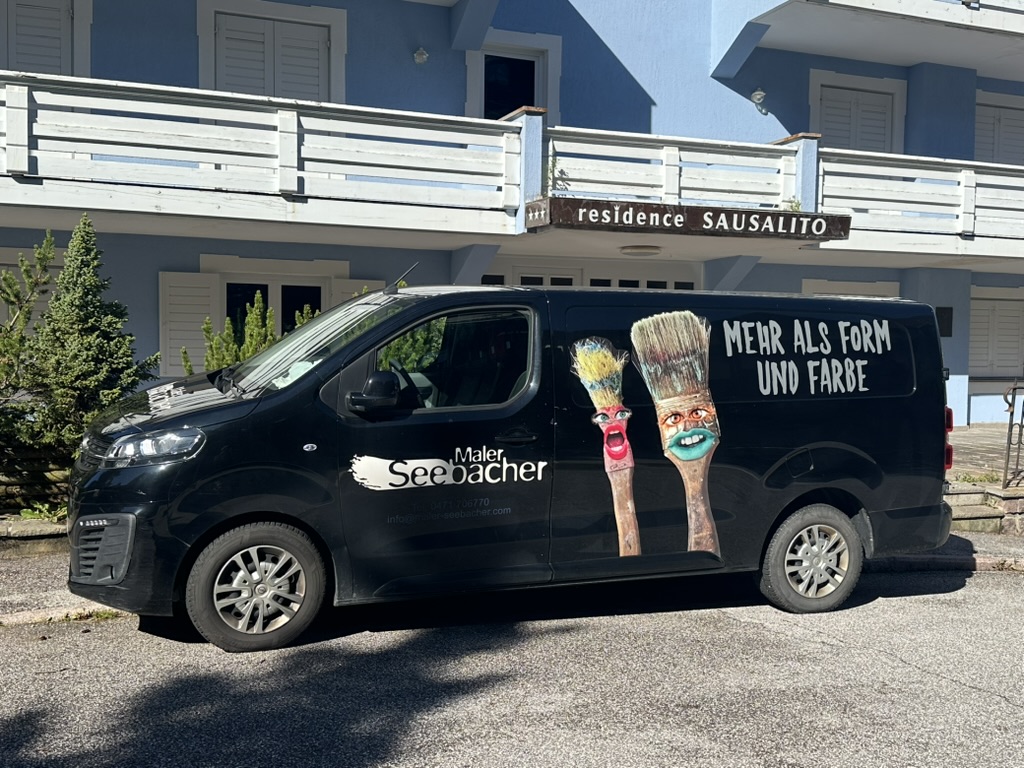
Bill’s mother would not have been amused by this depiction of forbidden emotions.
Being without your emotions is like being lost at sea, everything looks the same. There is nothing to anchor to, no way to get your bearings, no way to relate to people. It’s anxiety producing. When I was young, the anxiety came from feeling my emotions and knowing they were bad. As I got older, the anxiety was from finding myself in uncomfortable social and emotional situations I didn’t understand and not knowing how I got there. Plenty of stress to go around.
My professional life was filled with stress, sometimes unbearable. But of course, if you don’t have your emotions to guide you, you can’t tell it’s unbearable – you just carry on. My father had a heart attack in his early 50’s. In the moment he had the heart attack he knew what it was and that he should go to the hospital immediately. But he was a tradesman who owned his own business: he wasn’t afraid he was going to die, he was terrified he would lose his business because he knew he had a long hospitalization ahead. His response was to work day and night for 3 days to get his work caught up so his business could survive his absence. Never mind that those same 3 days are the critical time for complications and death for survivors of heart attacks. That’s why you immediately go to the hospital. So my lesson from that and other teaching opportunities was work comes first, above everything else, above your life, above your family, above everything. And, of course, so it was with me.
Being a successful doctor was all important. I was a neonatologist, a specialist in caring for premature and other sick newborns. The hours were long with excessive night work. The patients were very sick and our unit was busy. When you think of hospitals, you usually think of calm and quiet, but neonatal intensive care units in 1980 were not like that. They were horrifically noisy, crowded, bright places with emergencies of one sort or another exploding around you unexpectedly and sometimes simultaneously. The stress was everywhere and it was constant.
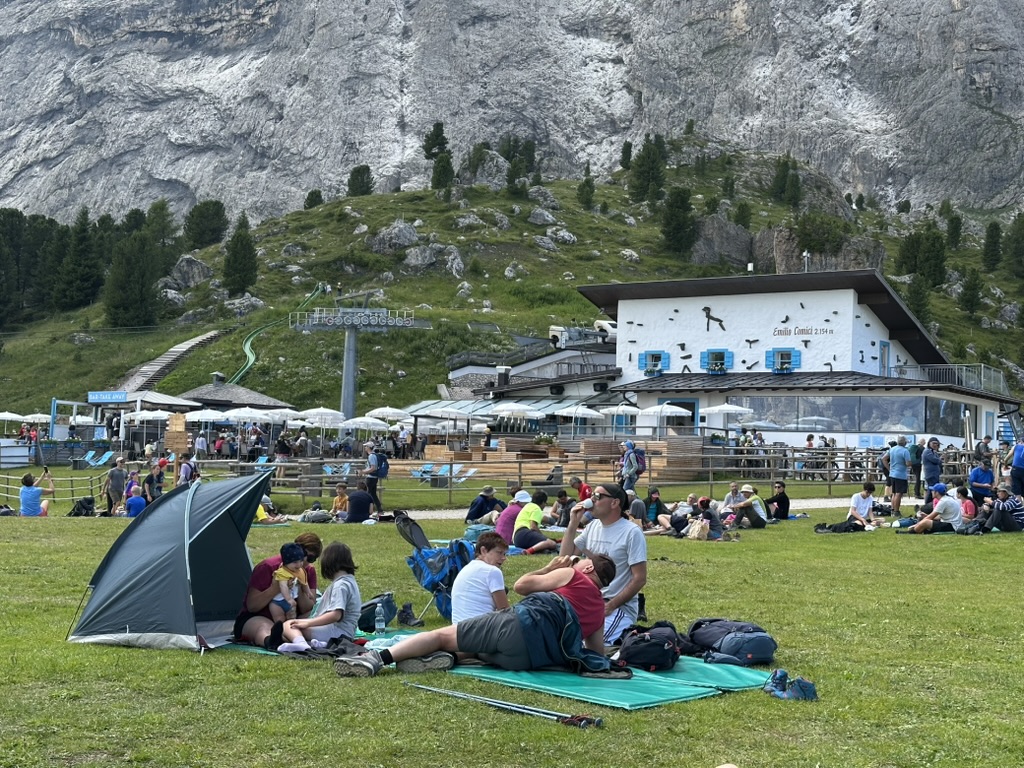
Enjoying downtime like this was unimaginable for much of Bill’s life.
But of course, when you’ve spent your entire life being stressed out, you can’t just turn it off. What do you do with your life when you retire at 50? We liked to cyclotour and had taken a few 1-2 week trips in the States when I could get the time off. We decided to up the ante and cycle around the world.
We sold most of our possessions, rented out the house, and headed to Europe. We never made it around the world because the September 11 attack occurred 3 months after we arrived in Europe. We enjoyed the lifestyle though, so instead of taking 1 or 2 years to go around the globe, we spent the next 10 years cycling 9 months of the year in Europe with a short return home to take care of our affairs. We accumulated about 7000 miles per year on loaded bikes (100 lbs), usually crossing the Alps twice each year. That’s an average of 175 miles/week every week. That’s a lot of miles, especially considering many of them were in the mountains. We did all our own trip planning and searched for food and lodging every evening after the ride. It was physically very demanding and the uncertainty of bicycle travel in foreign countries where we seldom spoke the language was emotionally stressful.
After 10 years of spending 9 months per year cyclotouring, we switched to only about 6 weeks of cyclotouring, but substituted hiking for our main source of exercise. In this period we hiked at least 2000 miles/year (about 40 miles/week average) with elevation gain between 250,000 and 350,000 feet per year averaging 5000-7000 feet/week (or 500-700 flights of stairs/week.) In addition, we were cycling about 1000 miles per year. This is a lot of exercise, especially between the ages of 60 and 73. While the emotional stress was much lower than earlier in my life, the physical stress was enormous.
Why did I do all this exercise? Moderation is not my strong suit. I had always pushed myself to achieve during my education and again during my work life. I just carried the habit over into my retirement. It turns out to have been a poor choice. As one of my cardiologists put it, “Long term endurance training is hard on the heart.” He thinks it’s the catecholamines that are constantly released (epinephrine & norepinephrine) that are damaging to the heart’s electrical system. Cortisol and its effects on inflammation likely also play a role, both in emotional and physical stress.
Though about 50% of white men my age or older have heart problems, my cardiologists frequently remind me that my situation is quite unusual because my heart problems are strictly electrical. All the blood vessels that supply the heart with blood are squeaky clean and the heart muscle itself is strong and healthy from all that exercise and our obsessively conscientious diet. My problems are limited to electrical only: my cardiac wiring is fried from a lifetime of stress and anxiety.
With this cacophony of recriminations and regret echoing throughout my tired brain when I intend to be sleeping, I realize I’ve done it again. I’ve spent precious sleep time worrying to the detriment of my next day’s wellbeing. I’m getting anxious about tomorrow, so it’s time to implement a familiar remedy: counting backwards from 100 with each count beginning on an inhale and ending on the exhale.
Bill On Looking Ahead
There are many other risk factors for atrial fibrillation in addition to stress. No doubt some of them, especially age, have also been contributors to my condition. However, what stands out for me is that these other confounders have been superimposed on lifelong, unrelenting stress, taking the form of emotional stress in my early life and physical stress in my later years.
The human body is miraculous. It has workarounds and contingencies beyond imagination for every problem and malfunction, but when you’ve used them all up, that’s it. You can feel fine until you exhaust that last bit of reserve in a given system, and suddenly, literally in an instant, what was accessible a minute ago is out of reach. I crossed that Rubicon on a beautiful day in June 2024 when I was suddenly exhausted strolling downhill on a village street and haven’t been the same since.
The good news for me is that my entire heart is not damaged – only the electrical system that controls its beating. My prognosis is very good if the heart rhythm abnormalities can be controlled. Western medicine has many tricks for accomplishing this, including medications and pacemakers, and so I am optimistic for my future health while I simultaneously continue learning how to corral my stress.
An Active vs Contemplative August
We each experienced our August 2025 “quiet time” quite differently. Almost all of my elective hours of the day were spent ramping-up my daily walking miles and elevation gain, reintroducing jogging in the form of shuffling for the first time in two and a half years, terrifying myself while learning to ride a bike again, doing sometimes-dizzying eye exercises to steady my gaze, doing an osteoporosis intervention exercise routine, and a performing a bit of strength training. I collapsed into bed every night from exhaustion. In contrast, Bill steadily decreased his exercise intensity to keep himself out of the Italian ERs. Our 2-mile sunrise walks together with some hills gradually became a relatively flat, 1-mile walk for Bill. He added in a 20” yoga routine while I walked for hours and eventually, we did a 10” core workout together. As some of my stroke deficits diminished, Bill’s physical ability waned. He spent hours everyday on his laptop working on our electronic photo album, learning how to use WordPress for building our page web, and other cerebral chores. He also kindly did almost all of our food prep and kitchen clean-up so I could go thrash myself for hours everyday.
Bill however made an epic breakthrough in his mental health during our quiet month. Quite unexpectedly, in the week Bill spent exposing his decades of layered anxiety and stress to himself and to me to write about it for our webpage, his lifelong anxiety began unraveling. On one sunrise walk during this brief process, he reported feeling an unusual sense of calm. On a scale of 1 to 5, he rated his constant undercurrent of non-specific anxiety as “1”, then it was below 1. A few minutes later, he was reporting more nuanced, below 1, perceptions. Coming to the realization that, contrary to his lifelong belief, he did have anxiety had taken years but like ‘reserves’ can instantly be gone, the grip anxiety had had on him also released almost in an instant. And just as amazingly, his anxiety that was always in the ready to be triggered didn’t return.